
Accessory Dwelling Units (ADUs)
This page provides an overview of accessory dwelling units (ADUs) for cities and counties in Washington State, including legal requirements and examples of city and county codes.
New legislation: Effective July 27, 2025:
- SB 5558 extends the deadline for counties and cities that have a comprehensive plan update due in 2026 from June 30, 2026, to December 31, 2026. Provides that certain requirements related to design review, middle housing and accessory dwelling units must be adopted at the time of the county or city's next comprehensive plan update, rather than six months after the update.
- HB 1353 allows cities planning under the Growth Management Act (GMA) to let registered architects self-certify that detached ADUs meet building codes. Cities must set rules and minimum standards, report to Commerce, and Commerce must report to the Legislature.
- SB 5529 expands the authorization for a property tax exemption for accessory dwelling units to include counties with a population of at least 900,000 but not more than 1.5 million and the cities located within those counties.
- SB 5184 prohibits residential parking requirements for units 1,200 sq. ft. or less in cities over 30,000 and repeals prior limits in RCW 36.70A.620.
- HB 1491 prohibits parking requirements for residences in station areas.
We will update this page to reflect the new legislation soon.
What Is an Accessory Dwelling Unit?
An accessory dwelling unit (ADU) is a small, self-contained residential unit located on the same lot as an existing single-family home.
An ADU has all the basic facilities needed for day-to-day living independent of the main home, including a kitchen, sleeping area, and a bathroom. As the term "accessory" implies, ADUs are generally defined to be smaller in size and prominence than the main residence on the lot. Some definitions include specific size limits, and a location that is not readily visible from the street.
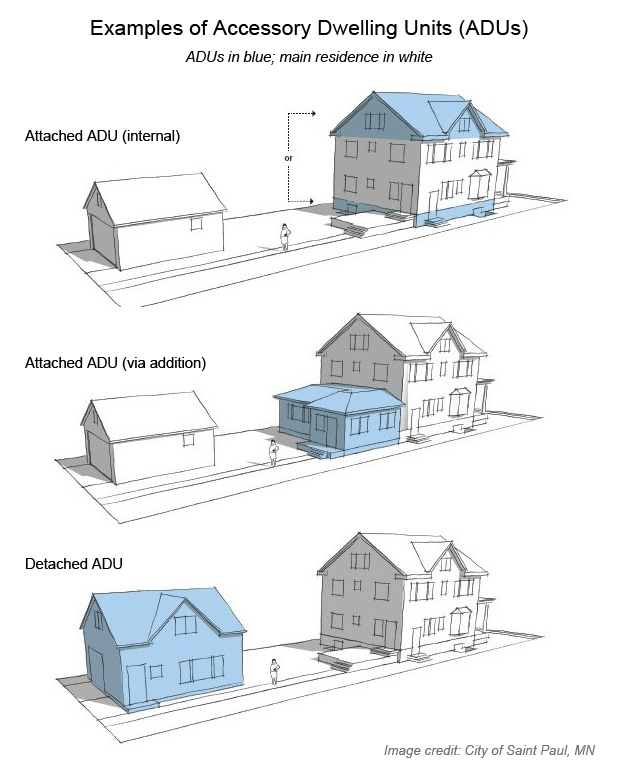
In theory, an ADU may be created as a separate unit within an existing home (such as in an attic or basement), an addition to the home (such as a separate apartment unit with separate entrance), or in a separate structure on the lot (such as a converted garage). See the examples shown below.
ADUs are sometimes called "mother-in-law apartments" or "granny flats," because they are often used to house extended family. Other codes use terms such as "accessory apartment," "accessory living unit," or "secondary unit," have a similar meaning.
Statutory Requirements for ADUs in Washington State
State law (RCWs 36.70A.680 and 36.70A.681) requires all local governments planning under the Growth Management Act (GMA), regardless of population and including counties (unincorporated urban growth areas) as well as cities, to revise their regulations as needed to conform, at the same time as their periodic update due date, with the following requirements:
- Minimum number of ADUs per lot: Two ADUs per lot must be allowed in all GMA urban growth areas, in addition to the principal unit, for lots that meet the minimum lot size required for the principal housing unit. Local regulations must permit ADUs to be attached, detached, or a combination. In addition, a conversion of an existing structure, such as a detached garage, must be allowed.
- Maximum ADU size standard: Local governments may not require ADUs to be smaller than 1,000 gross square feet in size.
- Dimensional standards: A local government may not impose setback requirements, yard coverage limits, tree retention mandates, or restrictions on entry door location that are more restrictive than those required for the principal unit.
- Street improvements: A local government may not require street improvements as a condition of permitting accessory dwelling units.
- Owner occupancy: A local government may not require owner occupancy for a principal unit or ADUs.
- Condominium sales: Local governments may not prohibit the sale or other conveyance of a condominium unit independently of a principal unit solely on the grounds that the condominium unit was originally built as an ADU.
- Design review: Local governments may not impose aesthetic standards or requirements for design review that are more restrictive for ADUs than those for principal units.
- Required parking: There are restrictions on how much on-site parking can be required, with a sliding scale for smaller-sized lots. No on-site parking standards may be applied to ADUs located within a half-mile of a major transit stop. Parking regulations must also comply with RCWs 36.70A. 620 and 36.70A.622.
- Impact fees: Impact fees for ADUs are limited to no more than 50% of those assessed to the principal housing unit.
- Common Interest Communities: New “Common Interest Communities” (for example, a new subdivision with a homeowners association) are prohibited from adopting covenants, conditions, and restrictions (commonly called “CC&Rs”) that would limit the construction of ADUs on any lot. Existing CC&Rs, however, are not impacted by the new law and may remain in effect.
Examples of ADU Codes in Washington State
Below are examples of selected ADU codes and ordinances from Washington State that have been updated to comply with RCWs 36.70A.680 and 36.70A.681.
For detailed guidance on compliance with all statutory requirements, including more code examples, see the Washington State Department of Commerce’s pages Guidance for Accessory Dwelling Units in Washington State (2024) and Planning for Middle Housing.
- Auburn Municipal Code Sec. 18.32.010 - Allows ADUs to be sold as condominium units or as separate pieces of property through a unit lot subdivision process.
- Bellingham Municipal Code Sec. 20.10.036 – Owner occupancy requirement is retained until preempted by state law.
- Bothell Municipal Code Sec. 12.14.135 – An ADU is allowed on a lot developed with middle housing.
- Clark County Code Sec. 40.260.020 – Includes design standards for ADUs on lots containing structures designated on a national, state, or local historic register.
- East Wenatchee Municipal Code Sec. 17.72.190 – Aims to provide homeowners with flexibility and increase the range of housing choices and the supply of accessible and affordable housing.
- Enumclaw Municipal Code Sec. 19.34.050 – Allows ADUs on lots of any size.
- Lake Stevens Municipal Code Sec. 14.44.045 – Requires minimum size of 250 square feet for ADUs.
- Moses Lake Municipal Code Sec. 15.415.010 – Short-term rentals of ADUs is prohibited.
- Port Townsend Municipal Code Sec. 17.16.020(C) – ADUs may be configured as duplex structures when detached from primary residence. Chapter 17.58 allows tiny homes on wheels as detached ADUs.
- Snohomish County Code Sec. 30.28.010 – Maximum floor area for ADUs is 1,200 square feet.
- Tukwila Ordinance No. 2731 (2024) – Attached ADUs may occupy up to 40% of the square footage of the principal unit or 1,000 square feet, whichever is greater.
Examples of ADU Programs Outside Washington State
Below are examples of innovative ADU programs outside of Washington State that have been successful at expanding ADU development by focusing on removing zoning and permitting barriers, reducing fees/waivers for ADUs, or other strategies.
- Portland, OR: Accessory Dwelling Units – Comprehensive information on Portland's successful program.
- Santa Cruz, CA: Accessory Dwelling Units – Detailed description of regulations of various types of ADUs, including ”statewide exempt” ADUs that are subject to only a limited set of development standards.
- Vancouver, BC: Laneway Housing – Part of overall program offering housing options in lower density areas.
Short-Term Rental of ADUs and Enforcement
In recent years, ADUs have been increasingly used as short-term rentals (STRs) on online platforms such as Airbnb and VRBO. This use of ADUs and other types of housing, has a negative impact on the affordable housing supply in cities. Some cities, such as Poulsbo, do not permit the use of ADUs as STRs. Others, such as Langley, limit the amount of STR permits approved for ADUs.
For more information, see the short-term rental regulation section on MRSC's page: Affordable Housing Techniques and Incentives.
Enforcement of STR Regulations
Enforcing STR regulations can be challenging because it is difficult for cities to determine how many or which ADUs are being offered as STRs on online rental platforms. As such, technology is playing a growing role in local enforcement of STR rules. Many cities, including Madison, Wisconsin and Charleston, South Carolina, are starting to use third party technology companies to monitor and report on STRs. Some large cities, such as Seattle and Los Angeles, have had the benefit of collaborating with Airbnb on enforcement (see Los Angeles Magazine article (2020)).
Examples of Short-Term Rental of ADUs and Enforcement
- Bellingham Municipal Code Sec. 20.10.03(B)(5)(c) – STRs are not permitted in detached ADUs in residential single general use type areas, unless citywide housing vacancy rate reaches 4% or higher, then the city council shall review whether STRs should be allowed in these areas.
- Chelan County Code Sec. 11.88.290 – Defines three tiers of STRs and limits them to a maximum share of the housing stock in residential zoning districts within specific subareas.
- Langley Municipal Code Sec. 5.40.030(F) – Limits the maximum number of ADUs, attached or detached, used as short-term rentals to 30.
- Poulsbo Municipal Code Sec. 18.70.070(A)(3)(g) – Does not permit the use of ADUs as short-term rentals. ADUs must be rented for a minimum of 90 days or more.
Recommended Resources
-
- Urban Land Institute: Jumpstarting the Market for Accessory Dwelling Units: Lessons Learned from Portland, Seattle, and Vancouver (2018) – Study examining best practices from Portland (OR), Seattle, and Vancouver, BC.
- Washington Department of Commerce:
- ADU Housing Checklist – A checklist for reviewing local government ADU codes to help ensure compliance with WA state laws.
- EZ View: Affordable Housing Planning Resources – Click on the ADU Guidance Update tab for additional resources and examples regarding ADUs.
- Guidance for Accessory Dwelling Units in Washington State (2024) – Detailed publication discussing benefits, regulatory issues, and zoning regulations for ADUs. Jointly prepared by MRSC and the Washington State Department of Commerce.