skip navigation

MRSC Insight Blog


Posts for Guest Author
The Connection Between Downtown Safety and Revitalization

Downtown revitalization often depends on public perceptions of safety in the downtown core. Localities can boost public safety through a variety of approaches, from local beautification projects to developing business improvement areas. 

Read more

Reducing Crash Severity with Speed Limit Setting and Speed Management

Many localities are interested in setting and achieving safe speeds on their roads to reduce rates of vehicle-related accidents and injuries. What are some tools and best practices agencies can follow to determine what safe system speeds look like for their communities?

Read more

How Lakewood Addresses Homelessness After the Grants Pass Ruling

Using an integrated approach, Lakewood relies on both regulations and support services to address homelessness and public camping within the community with the goal of moving unhoused individuals into stable living conditions.

Read more

Surface Mine Reclamation Program: Interaction with Local Governments

Surface mines are regulated by a variety of agencies, including the local government in which a mine is located. But what happens when a mine has reached the end of its productiveness? Can the land be returned to its pre-mining state, and which agency oversees this process?

Read more

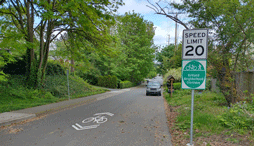
Reducing Local Street Speed Limits in Bellevue: Safety Starts on Your Street – Part 2

Following a multiyear, iterative process, the City of Bellevue lowered the default speed limit on city streets to 20 mph. How did planning staff work with the city council and other departments to coordinate such a huge effort, and what advice would they offer to others?

Read more

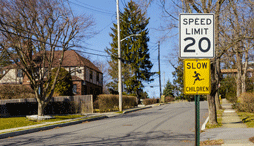
Reducing Local Street Speed Limits in Bellevue: Safety Starts on Your Street – Part 1

Partly in response to concerns about speeding, Bellevue lowered the default speed limit on city streets to 20 mph, but only after a three-year process that included laying the groundwork and running pilot programs to test the efficacy of lower speed limits on public safety.

Read more

Leases: A Critical Tool for Clean Buildings Act Compliance

The 2019 Clean Buildings Act creates performance standards for energy and water use in buildings. Building owners, including public agencies, can leverage lease agreements to support compliance with the law, reduce risk, and delineate landlord/tenant responsibilities.

Read more

Local Government Initiatives for Green Buildings in Washington: Policies, Codes, and Incentives

In Washington, the buildings sector is the state's second-biggest carbon polluter behind transportation, accounting for more than a quarter of statewide greenhouse gas emissions. How are local governments encouraging the development of green buildings to reduce emissions locally?

Read more

Indoor of a green building under construction

Advancing Green Buildings: Washington’s Clean Buildings Law and Green Building Practices Local Governments Can Adopt - Part 1

Since residential and commercial buildings account for 27% of statewide greenhouse gas emissions in Washington State, many local governments are implementing green building programs as part of a larger effort to reduce emissions and build healthier local communities.  

Read more

Tax-Exempt Entities: New Source of Funding Available for Clean Energy Projects

Local governments that undertook clean energy projects may be able to recoup some project costs through clean energy federal tax credits. Thanks to 2022 federal legislation, these credits are now available to certain tax-exempt entities as direct, elective payments. 

Read more

A bee on a yellow daisy

Save the Bees: How Local Governments Can Protect Pollinator Habitat

Pollinators are a critical component of a healthy ecosystem, impacting food security, the abundance of local flora, and agricultural earnings. Local governments can play a role in protecting critical habitat for pollinators with innovative strategies and smart land use policies. 

Read more

An employee and two supervisors during an employee disciplinary meeting

Understanding Loudermill Rights: Balancing Due Process in Employee Discipline and Best Practices

Loudermill rights protect the rights of public sector employees facing disciplinary actions. Employers must hold a pre-disciplinary hearing, which safeguards the right of the employee in question and ensures transparency, accountability, and fairness in employment decisions.

Read more

Aerial view of rural property showing graph of increasing dollar value

The Sheetz Decision: Agencies May Now Have To Show Their Work on Impact Fees

Under a new U.S. Supreme Court ruling, an agency may have to show how its impact fee calculations are related to land use interests and proportional to the impact of that development. (This blog updates and replaces one originally published in June.)

Read more

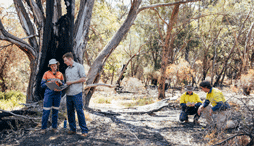
Team works together to collect data and make a wildfire plan

Is Your Community Ready for a Wildfire?

Which neighborhoods are most at risk for wildfire in your community? What are the priority actions your local government should take and where should these be concentrated? Developing a community wildfire protection plan can help an agency answer these questions.

Read more

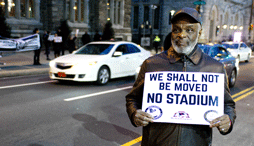
An older man holds a sign in protest of plans for a new stadium

Dealing with Housing Displacement in Your Comprehensive Plan

Housing displacement brought about by gentrification can severely disrupt existing neighborhoods. Thanks to legislation in 2021, any GMA-planning local government updating a comprehensive plan must also address and include anti-displacement strategies to protect residents.

Read more

A gavel sitting on top of a stack of legal documents

Public Defense Standards Are Changing: What Counties and Cities Need to Know

The Washington State Bar Association recently adopted revised standards that provide case load limits and other requirements related to public defense services. What are these new standards and what do local agencies need to know to be prepared for the change?

Read more

Key and keychain

Prioritizing Personnel Safety: Reducing the Risk of Distracted Driving in Your Agency

Public employers can actively protect their workforce from serious car-related injuries or death by developing a focused driving policy as a component of a strong workplace safety culture that also emphasizes traffic safety. 

Read more

3 children building with wooden blocks

Reducing Barriers for Childcare Facilities, Part 2

How can local governments support the development of more childcare facilities in their community? Well-thought-out zoning and development regulations can go a long way in helping to reduce the barriers for childcare providers.

Read more

A childcare teacher works with 5 young children

Reducing Barriers for Childcare Facilities, Part 1

Lack of access to affordable childcare may lead to a parent dropping out of the workforce, while convenient, affordable care creates economic advantages for families and communities. How can local governments support the growth of diverse childcare options in their communities?

Read more

A diverse group of happy adults and kids sitting in a garden

Whatcom County Boosts Engagement Efforts to Build a More Equitable Advisory Board

In order to contribute to building the health and well-being of young children and their families, Whatcom County developed a diverse, community-driven Child and Family Well-Being Task Force through innovative policies and increased community engagement. 

Read more

LOAD MORE